Shuga' Mommas

Shuga’ Mommas: Chocolate Chip Banana Bread

Oh, graduate wives. I have failed you.

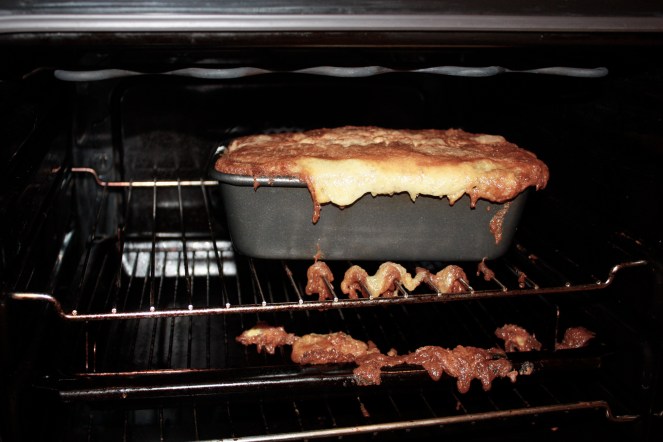
Today’s lovely post was supposed to have photographs, yes, BEAUTIFUL photographs of Chocolate Chip Banana Bread. Instead, this is what you get:

Batter batter everywhere!

I love to bake. Sometimes, the things I bake turn out so well, I start to get a bit prideful. (Go on, tell me I’m a great baker). And, it would have to be today, of all days, a day when chocolate chip banana bread should be photographed in all its gorgeousness, that this batter decides it has a mind of its own. “SEE!! You can’t put me in a bread pan! I will get out!” Personally, it was great reminder that I’m not Martha Stewart.

But, on most days, I can make a mean Chocolate Chip Banana Bread, and now, you can too!

CHOCOLATE CHIP BANANA BREAD

  • 1/2 cup butter, softened (use real butter, I promise it’s better)
  • 1.5 cups sugar
  • 2 egg yolks, beaten
  • 3/4 tsp baking soda
  • 1/2 cup milk
  • 2 egg whites
  • 2 bananas (one mashed, the other diced)
  • 1/2 tsp salt
  • 2 cups flour
  • 1/2 tsp baking powder
  • 1 tsp vanilla
  • I pkg of chocolate chips (frozen)

Pre-heat oven to 350F (180C).

Roll chocolate chips in flour. When baking, this will keep them from sinking down to the bottom of the pan.

With mixer (hand or stand) cream butter and sugar. Add egg yolks. In a separate bowl, stir baking soda into milk. Add to butter, sugar, and eggs. Add the mashed banana. Combine salt, flour, baking powder, and add to mixture. Stir in vanilla. Beat egg whites and fold into mixture. Add chocolate chips and diced banana. Bake for one hour.

And, please send me photos of your fabulous bread once you’ve baked it. I need to be reminded of what it’s supposed to look like.

Happy baking!

Mandy

PS You can omit the chocolate chips for some awesome banana bread.


Monday's Food for Thought

Monday’s Food for Thought: Reading Between the Lines

The below piece featured on Monday’s Food for Thought, comes from an online Christian journal, RZIM.  Although it is a blatantly religious piece, the words of truth it shares about biographies, are a crucial part of why TheGraduateWife.com exists.  To journey with each other and to discover that “the afflictions we find wearing are given meaning in the (biographical) stories of ones who have overcome much.”  Life is indeed too short for us to journey alone.

Reading Between the Lines

by Jill Carattini

On any given week, three to five biographies make The New York Times best-sellers list for non-fiction.  Though historical biographies have changed with time, human interest in the genre is long-standing.  The first known biographies were commissioned by ancient rulers to assure records of their accomplishments.  The Old Testament Scriptures, detailing the lives of patriarchs, prophets, and kings, are also some of the earliest biographies in existence.  Throughout the Middle Ages, biographical histories were largely in the hands of monks; lives of martyrs and church fathers were recorded with the intention of edifying readers for years to come.  Over time and with the invention of the printing press, biographies became increasingly influential and widely read, portraying a larger array of lives and their stories.

The popularity of the genre is understandable.  As Thomas Carlyle writes,

“Biography is the most universally pleasant and profitable of all reading.”  Such books are pleasant because in reading the accounts of men and women in history, we find ourselves living in many places; they are profitable because in doing so, we hear fragments of our own stories. The questions and thoughts we considered our own suddenly appear before us in the life of another.  The afflictions we find wearying are given meaning in the story of one who overcame much or the life of one who found hope in the midst of loss.  Perhaps we move toward biography because we seem to know that life is too short to learn only by our own experience.”

As a Christian, I am called to move similarly.  The most direct attempt in Scripture to define faith is done so by the writer of Hebrews.  The eleventh chapter begins, “Now faith is being sure of what you hope for and certain of what you do not see” (11:1).  To be honest, it is a definition that has always somewhat eluded me, and I was thankful to read I am notalone. John Wesley once observed of the same words, “There appears to be a depth in them, which I am in no wise able to fathom.”  Perhaps recognizing the weight and mystery of faith and the difficulty of defining it, the writer of Hebrews immediately moves from this definition to descriptions of men and women who have lived “sure of hope” and “certain of the unseen.”  From Noah and Abraham, to Rahab and saints left unnamed, we find faith moving across the pages of history, the gift of God sparkling in the eyes of the faithful, the hope by which countless lives were guided.  In this brief gathering of biographies, the writer seems to tell us that faith is understood functionally as much as philosophically, and that our own faith is more fully understood by looking at the lives of the faithful.  For in between the lines that describe faithful men and women is the God who makes faith possible in the first place.

At the end of his compelling list, the writer of Hebrews concludes: “Therefore, since we are surrounded by such a great cloud of witnesses, let us throw off everything that hinders and the sin that so easily entangles, and let us run with perseverance the race marked out for us” (12:1). The lives of those who followed Christ before us urge us onward, strengthening our hearts with stories of faith, stirring our minds at the thought of God’s enduring influence, reminding us that God moves in our biographies and yet beyond them.

Jill Carattini is senior associate writer at Ravi Zacharias International Ministries in Atlanta, Georgia.


Doing it Together (both in academia)

A Happy Life


                                                                                    written by Angie, a current graduate wife and student

“Happy families are all alike; every unhappy family is unhappy in its own way.”

So remarks Leo Tolstoy in his opening to Anna Karenina, and it seems his observation applies to graduate students, too. The happy ones usually have the same reasons for being happy— they find what they’re studying interesting to them, they have nice comradeship with other students, they have helpful supervisors, they make good headway on their work. But the unhappy postgraduates are unhappy for all sorts of different reasons— they lose interest in their research topic; they feel lonely and isolated in their work; they feel homesick or stuck in a town they don’t want to be in; their supervisors are unsympathetic, unhelpful, or unavailable; they feel paralyzed by the mountains of reading and writing to do; they have writers’ block; they get intimated by the academic world and its intense competition and pride; they have financial struggles and burdens of loans or family financial sacrifices, and a constant questioning of whether the money spent on their education is justifiable; they have a hard time being present to their families; they have a constant sense of not having enough time; they have loss of vision and vocation and wonder why on earth they ever thought it was a good idea to start those degrees.

My husband and I are both PhD students, and between us we’ve felt most of those things. At the moment I’m more in the happy-student-camp, while my husband has been fighting off a flood of factors making him an unhappy student. Even though we’re doing the same degrees in the same university, the same department, and even the same area (Old Testament studies), we’ve had really different experiences. Maybe it’s because I’m a year ahead of my husband that I have more hope— I can see some glimmer of not being a student anymore!— but our experiences have made real to me how different each graduate life can be. All sorts of factors can make it enjoyable or miserable, and each person has different understandings of why they’re studying and how that study fits into the wider work they feel drawn to do.

But I think Tolstoy may have been off in his assessment of happy families—they actually are happy in different ways, too. And so, I must now qualify, are graduate students. It’s possible to be happy in the graduate life for different reasons, and there are healthy and unhealthy ways of finding that happiness. Some postgraduates base their happiness on their success in the eyes of the academy (how many publications, conferences, accolades they have under their belts), and they have their self-worth wrapped up in their achievements as academics. This seems to be the most common form of unhealthy happiness in academia— I see a lot of students fall into that trap, and it’s hard to get out of. But at the end of the day, it won’t give a lasting happiness, as all success is relative. It hardly ever is enough. My husband and I have had a long haul of learning that our work is not who we are, though the two things are related. Even as our work is part of our passions and interests and callings, it does not determine our worth, nor can we base our happiness upon it.

So we’re learning instead to seek out the deeper reasons for being happy in our studies, knowing why we’re studying, how our work might be formative in making us into the persons we’re called to be. What I’ve learned most these past six years of postgraduate life is that how one studies matters. A theologian I’ve been reading, Karl Barth, taught me that, as he said, “The real value of a doctorate, even when earned with the greatest distinction, is totally dependent on the degree to which its recipient has conducted and maintained himself as a learner. Its worth depends, as well, entirely on the extent to which he further conducts and maintains himself as such.” Learning, whether as a graduate student or as any other calling in life (including the calling of being a wife!), is a deeply personal act, an act that involves not just the mind and specific practices, but even more so the soul of the learner and the kind of life she goes on to lead.

And so, what we’re seeking on this graduate journey is in all things to journey in our hearts towards becoming the persons we are called to be. The writer of Psalm 84 puts this well, as he says, “Blessed are those whose strength is in You, in whose heart are the highways.” It seems the psalmist is saying that those highways are not the roads of particular situations one is traveling upon, but rather, the groves of one’s heart that are being worn as one lives, the ways one’s heart is heading in all things. What matters most is the way one is journeying and growing in her heart. A heart of highways that is ever striving towards more lasting and beautiful and broader things— that’s something needed for all of us caught up in this graduate life, happy and unhappy alike. And with those hearts of highways, we may come to find ourselves, wherever we are and however it’s going, somehow happy and at home.

In your graduate wife journey, how are you finding your journey of happiness?

Beauty and the Budget

Beauty and the Budget: Project ‘necklace make-over’

Children · Monday's Food for Thought

Monday’s Food for Thought: My Family’s Experiment in Extreme Schooling

One of the great things about being in the world of academia (or law school, graduate school, med school) is the fact that I often feel like I get to ride on my husband’s intellectual coattails. Our dinner conversation is often peppered with, “I just read a great article,” or “Did you listen to that podcast?” or “You’ve got to check this blog out!” I learn daily from my husband, and I think his time in graduate school has increased my own love of learning, reading, and thinking, even though I don’t have the desire to do that in a classroom. Ever. Again. :)

All that to say, the conversations amongst our graduate wife friends are often the same; we swap news articles, talk about documentaries, give book reviews, and discuss blogs…some of it is related to the graduate wife life, and some of isn’t, but it seemed like a natural fit to share that all with you, so….

Welcome to the first segment of Monday’s Food for Thought. 

Following on Michelle’s post from last week, this week’s article comes from The New York Times Magazine, and is an interesting read on a family’s move to Russia, and how they coped with the language and school they attended.

We hope you enjoy it!

Mandy & MC

Children · Family · Moving · Patience

Helping Children Put Down New Roots

                                                                                                  written by Michelle – a former graduate wife

In the summer heat, my boys are restless and roaming the house looking for their next adventure.  Hoping to provide some direction for their boundless energy, my sister asks if we would help her transplant some potted plants.

“Yeah! Digging and dirt!” shouts one.

“I want to hold the hose!” chimes in the other as he sprints out to the back patio.

She brings a basket of plants outside that have grown too big for their original pots.  Browning and overcrowded, they clearly need more dirt, fresh nutrients . . . something to bring new life back into withering leaves.

My boys hover over pots and sacks of Miracle-Gro.   Soon, clay pots are filled with new soil and small shovels loosen plants from old containers, their roots twisted and tangled together.  The perfectly pot-sized clumps of roots are placed in spacious pots and new dirt secures them in place.  My younger boy comes by with a miniature watering can to finish the job.

This small bit of gardening took all of ten minutes, but now as I sit in the evening quiet, my thoughts come back to this transplanting idea.  I am thinking about how many times my family has been transplanted during the course of my husband’s studies.   I am remembering what it was like to tell our kids we were moving again and how we attempted to guide them through the transitions.

Even my rowdy 3 and 7 year old boys can transfer a strong, established plant to a new pot with a little bit of focus, but it can be difficult to move a seedling successfully.  Moving children is a lot like attempting to transplant seedlings.  Their roots are tiny, fragile white threads and they never seem to balance properly in the new pot.  We moved five different times during our graduate journey and each time friends and family were keen to reassure us:  “Oh, don’t worry – kids are so resilient!  Especially at such young ages!”  or “Kids pick up new languages almost instantly.  They soak it up like a sponge. ” And yet, each time we moved, my children did struggle.  And learning a new language and going to school in that language was hard work for my older son.  After a few moves, I began to be of the opposite mind as my well-intentioned advice givers.  I came to realize that my children actually do hear and understand and feel a lot more than I sometimes realize.  Especially because they are fragile and not fully formed (much like seedlings), my boys need to be given opportunities to process what is happening if they are going to transition without problems.    So, in this piece I would like to explore ways we can help our children during a move or major transition.  Some ideas come from what we have tried in our own family and I have also added some ideas from the moving chapter of the book Third Culture Kids.

1)     Introducing the Idea of Moving

a)     Before our most recent move, my husband set up a series of bedtime chats with our sons (then 5 and 1) in which he told them about “God’s special plan” for our family.   We told the boys that we felt that God was directing us to move in order to follow His special plan.  We also had a night in which we talked about the fact that God has a special plan for each of their lives and God may be using some of our travels to prepare them for their futures.  These chats were given in bite-sized pieces they could understand, usually with a map nearby and time for their questions.

b)     We marked on a map where we lived (Germany) and where we were moving (England).  In order to create some excitement, we tried to make lists of things the children might like about our new city.  If possible, it is great to find pictures of the school the children will attend or pictures of the house/apartment that you will live in and its surrounding neighborhood.

c)     Read books about moving and talk about how the different characters might feel.  Try to find one with clear pictures of what happens during the packing up of an old house, the unpacking at new house, saying goodbye to old friends, making new friends, etc.

d)     For very small children, it can be helpful to play “moving games” in order to just introduce them to what a move is.  We did this some with our youngest in our last move a couple of weeks before we left.  I gave him a couple of empty boxes and we would pack up toys and move them to the next room and unpack them, explaining that this is what we were going to do later with all of our stuff.  Also, during all the events that precede a move and happen during a move, it is good for the parents to “frame” what is happening:  “Look, Daddy and his friend are putting the boxes in the van.  They will bring all of your toys safely to your new room.  Just like our game!”  or “We are waving goodbye to our old house.  We will have a picture of it in our photo album, but now we are going to live in our new house.”   When things get busy, it is easy to forget to include our young children in what is happening by framing it in words they can understand.

 2)     Giving a Sense of Closure

a)     As it got closer to our moving date, we wanted the kids to have a chance to think about all the people in our current home who have been important to them (church leaders, teachers, friends, neighbors, family members, etc.) and also the places we have been that have been meaningful.

i)      People: Children can write notes of appreciation, draw pictures for special people,  or think about leaving a special momento with a close friend or family member

ii)     Places that hold important memories:  Visiting these places one last time, reminiscing, and getting a special photo or hiding a treasure or note to hopefully find again there someday. 

3)     Easing the Actual Transition

a)     Use of “sacred objects”:  For some of us who are making international moves, it is just not possible to take much with us.  How do you deal with this?  We met one family who had a policy we really liked.  Though they moved often, they made sure they always kept a few of their children’s most valued possessions:  some quilts their grandmother had made them and some special dishes made for them by a friend.  The quilts were unpacked first thing and spread over the beds and then their dishes were set out, helping to create a feeling of “home” for them.  Though the quilts were bulky and the family was sometimes very limited on space, these “sacred objects” were always a priority.  Having a set of “sacred objects” as they are called in Third Culture Kids helps to give the kids some stability.

b)     Keep as many family rituals in place as possible – Keep the days and weeks as normal as you can.

c)     Plan for a period of misbehavior and general adjustment.  You, as the parent, are going to need to give a lot emotionally and the kids are going to need you more than normal.  Their behavior is almost guaranteed to be crazy for a while. Give them grace – moving can be even harder for little ones who had no control in the decision that has resulted in their entire world changing.  Keep close tabs on how kids are doing emotionally – you will be very busy and overtired but keep your eye on signs that something might be off with them.  Help them to name feelings and provide acceptable outlets to express feelings.

d)     Make contact with some other families in the area or at the same school as soon as possible (in advance if you’re lucky enough to have the opportunity!)  Don’t expect your new community to initiate having a relationship with you – be prepared to go out and actively seek out community for your family.

e)     One way we have eased the transition for our family is by sending my husband ahead first.  When we moved to Germany, he drove our possessions to our new apartment with a friend a few days before we arrived.  It made a big difference for our five year old, because when he first saw his new room it was completely unpacked with all of his familiar toys out and favorite posters on the walls.  Instead of a weird feeling of not belonging in a small white-walled, empty room, he seemed to feel at peace and slept alone in that room on the first night.  It also helped lessen the stress for me because before our arrival my husband could purchase some preliminary groceries and a map and scout out the neighborhood.

f)      For those of you who are moving internationally, I strongly urge you to learn all you can about the language and culture ahead of time.  Of course, no matter how much you prepare, you will still be learning a lot as you go through life in your new country.  Your children can learn a lot by watching how you handle the experience.  Describe how you are feeling about learning all these new things.  Present it as an exciting new adventure, but acknowledge that it can be overwhelming at times and that’s normal and okay to feel that way.  Try to laugh at your mistakes and move forward so the children know that when they make mistakes, they can learn from them and move on without feeling ashamed.

Taking some time to put some of these ideas in place (and maybe add to them with some of your own!) can really make a difference in how your children react to a move.  We all hope that our kids, if they must be transplanted to a new place, will adjust to the soil and be able to drink deeply of the water and nutrients that a new experience can offer them.  With a little bit of planning and effort, you can help give them the best possible start.

In your graduate wife journey, how have you prepared your children to move to another country, city, or state? Did you do anything specifically?

Expectations · Moving · Sacrifice

The Courage of Exploration

                                                                                             written by Sarah – a current graduate wife

So there I was, sitting at a cheap, plywood table in Newcastle England, starting blankly into a MacBook, more than 3,000 miles away from where I wanted to be.

How did I get so far off course, you might ask? Well, pull up a chair and lend an ear. My story is one a graduate wife can appreciate.

Some of you might remember what it is like to have a great career. I can still hear the hum of the printing press and feel the thick tension in the air as I tried to get a newspaper out on deadline. As a reporter and editor for our local newspaper the days were 100 mile-per-hour marathons, both exhilarating and exhausting. Since I was a little girl I had dreamed of this career. Every extra-curricular activity, internship and my university education had been strategically designed to make me a super reporter.

In my early 20s, I had almost made it. I was an editor at the local paper. The job title, awards and offers proved that I had become a small town Lois Lane. But I was aiming higher.

Then I met my husband.

He was intelligent, ambitious, a Matt Damon look-alike, and I was in love. He was also applying for medical school.

After a year of dating and applying for schools, we were married. On our one month anniversary he was accepted to a medical program – out of the country. We would be moving once a year for the first four years of our marriage, or more if fellowships and residencies dictated.

Like a monkey wrench thrown into the cogs of a printing press, my dreams came to a grinding halt. For this next season of our lives it would either have to be his career or mine on the chopping block – we couldn’t do both. With a few tears, I carefully packed up our unopened wedding gifts, cleaned off my desk and moved to England. I doggedly looked for a job. Anything. Sadly, there were no jobs there in newsroom administration, especially for a transient who would stick around for less than a year. This foreigner couldn’t make headway in the reporting business either – I didn’t know a bobby from a bodge.

Do you ever feel resentment for the sacrifices you have been asked to make?

My bitter tears and empty days alone in a foreign country were poison to my budding marriage. I knew I needed to find an antidote.

A wise comedian, who also found himself 3,000 miles from where he wanted to be, once said, “There are few things more liberating in this life than having your worst fear realized.” Conan O’Brien might have been speaking to graduating academics at Dartmouth, but his words resonated with me. He continues:

“I went to college with many people who prided themselves on knowing exactly who they were and exactly where they were going. At Harvard, five different guys in my class told me that they would one day be President of the United States. Four of them were later killed in motel shoot-outs. The other one briefly hosted Blues Clues, before dying senselessly in yet another motel shoot-out. Your path at 22 will not necessarily be your path at 32 or 42. One’s dream is constantly evolving, rising and falling, changing course.”

As a newly-minted graduate wife, change was my only constant and adaptation my only antidote.

Somewhere in that foreign London fog of change and hopelessness, I started trying new things. I explored. I blogged. I taught myself how to design a website. I adapted.

Fredrick Nietzsche famously said “Whatever doesn’t kill you makes you stronger.” But what he failed to stress is that it almost kills you. The loneliness, the disrupted career path and the stress in my marriage almost killed me. But for those who are stuck in the middle of that mire, I promise that on the other end of your effort there is peace.

My blank stare into that MacBook on that plywood table in that cold, dreary place turned into a journey of exploration. But only because I made it so. Conan was right – there is nothing more exhilarating than having your life flipped on its head and, through your own sheer force of will, flipping it right side up again. When you finally straighten things out, your dreams might look a little different. But because you were the one to do the changing, somehow those new dreams are alright.

Sacrifice became what I made it. It was still painful, but only as painful as I would allow it to be between the bouts of blogging and exploring.

We have survived our second move now and are tripping blissfully and blindly into year three of marriage and year two of his late night, blood-shot eye studying. We have learned that those who adapt, survive. I am a survivor.

What strategies have you found successful in your transition to a graduate wife?

Shuga' Mommas

Shuga’ Mommas: Carrot and Coriander Soup

Autumn is my favourite time of year. It invokes fond memories of high school football games, pumpkin carving, warm sweaters, apple cider, falling leaves, crisp mornings, and the smell of cinnamon.

I know you didn’t come here to read about the nostalgia of my childhood, so let’s talk about why you came by here today: soup.

Growing up, I didn’t particularly like soup. Now that I am older (and wiser), and living in a colder climate, soup seems like a must. There is nothing better or more filling than a warm bowl of soup on a cold day.

After moving to England, one of my friends introduced me to Carrot and Coriander soup, and our family fell in love with it immediately. It’s cheap. It’s easy. It’s healthy. It freezes well. What more could you ask for when time AND money are precious things in this graduate wife life?

CARROT AND CORIANDER SOUP   (This is my own variation of several recipe attempts)

  • Extra virgin olive oil
  • 1 medium onion
  • 1lb carrots
  • 3/4 tsp of ground coriander
  • 32 oz of vegetable stock (can use more, if you’d like it a bit more soupy)
  • Handful of coriander (the English fancy pants word for cilantro – for you North Americans)
  • Salt and pepper to taste
  • Cheese (cheddar, gruyere, parmesan etc whatever you like)

Slice carrots and onion, and saute on high for a few minutes until soft. Sprinkle with 3/4 tsp of ground coriander, stirring until carrots and onion are coated. In a separate stock pan, turn vegetable stock on low. Throw carrots and onion into stock, and cover, allowing it to simmer for 30 minutes. Remove cover. Add handful of coriander, salt and pepper. The soup is now ready to be puréed. You can either use a food processor on an immersion blender (I prefer immersion blender). Blend until soup is smooth. Divide soup into bowls (this recipe will serve 4), and sprinkle with cheese. Add a side of warm bread (garlic, french) to complete the meal!

Carrot & Coriander Soup

And, as my husband’s French grandfather would say, “bon appétit!”

Here’s to a delicious autumn,

Mandy

Expectations · Family · Inspiration · Marriage · Moving · Patience

The Glad Game

                                                                                                                       written by Stephanie – a current graduate wife

The movie Pollyanna has forever been one of my all-time favorites.   Pollyanna played “The Glad Game,” and her eternal optimism infected everyone around her.  Even in the face of adversity, she believed that there was always SOMETHING you could find to be glad about.  I think we could all learn a little something from Miss Pollyanna Whittier. As a graduate wife, I have tried to adopt this philosophy as best I can.

My husband Josh is now amid his second year of medical school at St. George’s University in the Caribbean.   His first year was spent in Newcastle, England as part of the Global Scholars Program.   We had been married for only 4 weeks when we boarded that international plane to the United Kingdom.  Talk about a whirlwind first year.  It took me months to feel connected to anything and anyone in England and by the time it started to feel a little bit like “home,” it was time to uproot and move again, this time to the 22 mile long island of Grenada.   We will leave Grenada in May 2012 headed for hospital rotations in the States, but we won’t know exactly where we are going until weeks before we go.   Two years of rotations, God willing in the same place, will only be followed by a residency that will more than likely move us yet again.  I try to take each day as it comes, because thinking too far into the future only gives me a panic attack.  Not having a place that I can really call “home” is challenging.  I sometimes envy the graduate wives who get to, at the very least, stay in the same place for the duration of their husband’s schooling.

GLAD:  At only 25 years old, I am GLAD that I have had the opportunity to do this much traveling so early on in my life.   I’m GLAD that I get to experience all of these exotic places with my best friend.  It’s not a vacation like so many assume, but it IS a once in a lifetime experience.

Medical school is no walk in the park.  Josh studies ALL the time and there are many nights where I eat alone, watch romantic comedies by myself, and go to bed solo.  Date nights are often canceled because there just aren’t enough hours in the day to study.  Many holidays and birthday celebrations have to be put off because finals are only days away.  I do all the cooking, cleaning, laundry, and grocery shopping.  I manage our finances, keep up with the financial aid paperwork, and stay in contact with our families and friends.  On my worst days, I feel like leaving and going home to California because after all, besides not having food in the fridge, a home cooked meal, or clean underwear, would he ever even notice I was gone?

GLAD:  I am GLAD that Josh is pursuing his dream of becoming a doctor and excelling in his classes, in part due to my support.  I am GLAD that having so much alone time has allowed me to take up hobbies that I always hoped I’d have time for.  I scrapbook, read, send letters to friends and family, exercise, participate in volunteer work, and started a blog

Most days of the year, we are thousands of miles away from our family and friends.  Last year we missed Thanksgiving, 4th of July, Easter, birthdays, friend’s weddings, family vacations, and so much more.  We see our families through Skype more often than we see them in person.   On top of that, we have nobody to run to when we are upset with each other, and nobody’s house to go to in order to get away for a little while.

GLAD:  There are times I am GLAD that we can’t run to anyone else when we are struggling with each other in our relationship.  It has forced us to work through our issues without the interference of our family and friends opinions.  When you live half way across the world from everyone you know, the only person to turn to is God and each other and because of that, our relationship has grown immensely this past year.

I didn’t go to graduate school.  Admittedly, this has been the hardest part for me in being a graduate wife.  There was a time when I was not going to be the graduate wife.   I was going to be the GRADUATE STUDENT.   I did all the work leading up to actually going to school.  I got my Bachelor’s Degree in Kinesiology.  I did over 2,500 hours of work in the field.  I applied to more than 15 doctorate programs, wrote 13 essays, got the recommendation letters, filled out the applications, took the GRE, paid the money to apply, and went to the interviews.  My hard work paid off.  I got in to a Doctorate of Physical Therapy program in Southern California.  I even paid the deposit to hold my spot for the August 2010 class.  But when Josh got into school and the decision had to be made whether or not to follow my soon-to-be husband to England, or to go to school myself, I made the decision to follow him.  Unfortunately, there are times when my resentment creeps up.  Moments when I think to myself, “What if I was in school right now?”  “What if I wasn’t following Josh around the world?”

GLAD: I am GLAD that I made the decision I made.  While being a physical therapist was my dream career, I reasoned that school would always be there if I wanted to go back, but I could NEVER get my first few years of marriage back.  Being on this journey with Josh has allowed us to become closer to one another than I ever could have imagined.  We are growing together.  Every week, I see subtle changes in us, changes that, if we weren’t physically together, would seem HUGE later on.   While my career aspirations might have thrived while I was in school, my marriage would have suffered.  And so I am GLAD that I’m here, on an island, growing and changing together with my husband.

Sometimes, as a medical school wife, it’s really challenging to find the GLAD in any given situation and on any given day.  But it is there.  It’s always there.  It might be a really small thing to be glad about, but if you look hard enough, you will find it.  If you can at least find a little bit of GLAD then it helps make the bad not so bad anymore.  Try to find the “Pollyanna” in yourself on a daily basis and I guarantee you will be a happier graduate wife because of it.

Do you ever find yourself playing “The Glad Game” in order to make dark days seem less dark?  If so, what do you find to be GLAD about?

Shuga' Mommas

Shuga’ Mommas: Red Wine Chicken (an anti-recipe)

Written by Tori – a former graduate wife

This dish is so easy and delicious.  I really can’t call it a recipe, because you can adjust all of the measurements and even the ingredients to your particular taste.  It is great to make for guests, or for a treat when your hubby needs a break from the studies.  We love it!!

Directions:

  • Two boneless chicken breasts, split down the middle (sliced while standing on one side, so you now have four thin cutlets), and sprinkled with salt and pepper.
  • Heat couple of Tablespoons of olive oil in a pan, and brown the chicken on each side.
  • Slice half of a yellow onion and two large cloves of garlic, adding to the pan with the chicken until the onions begin to soften.  If you like mushrooms, this would be a great time to throw some in as well.
  • Sprinkle the top of each chicken breast with around a 1/2 Tablespoon of brown sugar, and then add around 1 cup of red wine (I used a malbec, which was delicious, but you don’t need anything expensive!  I do not recommend “cooking wine”, but any cheap wine that you would actually drink is perfect).
  • Baste a little of the wine and onions over the chicken, cover, and let simmer for at least 15 minutes.  Give it a taste, adding more salt and pepper as needed- or maybe you want a little more brown sugar!  Be careful- it gets sweet quickly!
  • If you want the sauce to thicken up remove the lid to help it reduce down, or whisk in a teaspoon of cornstarch.

Simply boil some pasta, and when it has about a minute left, toss in fresh broccoli so that it became bright green and crispy-tender.  Drain it, cover it with butter and salt, and pour the chicken and wine sauce over it all.