Friday Funnies

Friday Funny: Grad School Barbie

REBLOGGED from Joanna Renteria:

A new gift idea for your loved ones: Graduate School Barbie (TM).

Graduate School Barbie comes in two forms: Delusional Master’s Barbie (TM) and Ph.D. Masochist Barbie (TM).

Every Graduate School Barbie comes with these fun-filled features guaranteed to delight and entertain for hours: Grad School Barbie comes out of the box with a big grin on her face that turns into a frown after 2 weeks or her first advisor meeting (whichever comes first). She also has adorable black circles under her delightfully bloodshot eyes.

Read more here

Wonder what Grad School Wife Barbie would look like? :)

~Mandy & M.C.

Expectations

24-7-365

Ever wonder what goes on in your graduate’s head? I know I do (and did)! I asked my husband, Casey, to write about his research experience, along with the possible psychological ramifications of being an academic. I understand that everyone is different, but it’s nice to have the perspective of a grad student who has walked the journey. ~Mandy 

-written by Casey, a former grad student

Don’t be like Mike…..

I’m a sports junkie, I have no problem admitting that.  So, I vividly remember the Gatorade ad campaign from the ‘90s that encouraged me and other kids to be like Michael Jordan.  Think what you will of Jordan now (post hall of fame speech), but the idea was straightforward: imitate the person you see succeeding and be successful yourself.  While there is some truth in that message, it can be very, very dangerous in academia.

Right now, somewhere, there is someone in my field who is reading a book.  Every time I stop to rest my weary brain I know that someone else is reading a journal article… probably in German.  I can never forget the casual chat with someone at a conference when they mentioned offhand how they do Latin vocabulary cards on their smart phone while waiting in queues.  And, of course, there is the seemingly weekly occurrence when I find out someone just got an (another) article accepted in a prestigious journal.  I need coffee; it’s time to go back to work.

This is what I used to tell myself when I would make coffee late in the evening to charge up for a four hour reading and writing session.  It is also what I would tell myself the next day when I read the output of that session only to realize it was rubbish.  Irretrievable rubbish.  For a long time I believed this narrative was an indication of my capabilities.  Then I got some sleep.  Not one night of eight hours—though that always made a positive difference—but a month worth of decent sleep.  And I read a book without footnotes.  For pleasure.  I played a round of golf and, afterwards, I watched a football match.  Scandalous, I know.  With just a few weeks of mental rest and distraction, I had ideas again.  A few of them weren’t rubbish.

I submitted my doctoral thesis when our son was 13 months old and still sleeping in our bedroom: you see, it was the only place in our one-bedroom flat that was quiet enough for him to do so.  I worked all day as an adjunct lecturer and, for the better part of 6 months, did my research and writing from 9 PM to 2 AM.  I’m a morning person, by the way, so this is even more insane than you think.  My son usually awoke between 5 and 6 AM, thus so did I.  That was my silly schedule; what is yours?  It’s probably worse.  But you can’t stop, can you?  ‘That’ person is now reading an essay… in French… and you’ve never even heard of the author.

Research is alluring because of the potential that you will find something never seen before.  There is always a new and intriguing topic to explore, a new possibility for making a link that answers an open question.  That same boundlessness makes researchers perpetually feel there is more to do, because there is.  You can always read another book, article, or essay, and surely you could be a bit more proficient in a foreign language, a computer program, or the like.  You never know when you’ve finished your research because that is a question that can’t be answered.  Research is like a race without a finish line, so it feels as if you can never run fast enough or far enough to reach the goal.  Because of that dynamic, any signal that someone else might be working harder than you can be (mis)read as a sign you’re not working hard enough.

I’m a workaholic.  If you’re reading this, there is a very good chance you’re a workaholic as well.  Grad school and doctoral programs attract workaholics like mosquitoes to a blue-light zapper.  What they don’t do, however, is warn you that this psychological tendency increases the probability that you will lose all sense of work-life balance while you’re doing your degree.

Among the things that I learned through doing a doctorate and living in the hellish purgatory that is post-doc, adjunct teaching are these two.  First, no one can read everything or know everything you think could be relevant to your research.  Not. Physically. Possible.  Second, it is your unique, individual perspective on whatever you’re researching that is more likely to provide the critical insight than is reading more stuff than other people.  When I finally learned the first lesson I was able to think of research as a strategic endeavor (I try to read what matters, I don’t try to read everything).  When I grasped the second I recognized that my single greatest strength as a researcher was being me.  And that meant I didn’t have to be like anyone else, not even the most successful person I knew in my field.  My particular constellation of experience, interests, and quirks (of which there are many) allows me to see problems in a fresh way and hopefully to offer new solutions to them.  I had to be me to be a good researcher, and that meant finding time for those things that made me who I am before grad school.  You know, back when I had a life outside the library.

What is it that makes you you?  Music; art; sports; cooking; movies; watching funny videos on the internet with friends?  Make time to do that.  If you don’t you’re cheating yourself in two ways: not only are you turning your brain into mush by not giving it a rest, you’re stifling the thing that could make you a distinctive researcher.  If you aren’t you, then you’re just a poorly engineered reading and writing machine that will break down sooner rather than later.

Monday's Food for Thought

Monday’s Food for Thought: Higher education – Right or privilege?

new food for thought

Is education a right or a privilege?

Or better yet, is higher education a right or a privilege?

With education costs soaring, and fewer jobs available for those wishing to pursue work in the academy, it’s a good question to ask. I ran across this article awhile back, and it took me back to the first discussions my husband and I had about going to grad school. We didn’t know if the cost was worth it, if we wanted to carry debt, or if he would end up with the job he wanted at the end of it. But, we decided to take the plunge and do it.

I wonder sometimes, as I’ve watched friends struggle with balancing growing families (and budgets!) and their school debt, if it really is worth it. I know it’s an incredibly personal choice to pursue a higher degree, but often finding a way to make it work, even after landing that dream job, can be difficult.

Great excerpt from the article:

The cost is making people wonder whether college is worth it. In the survey of the general public, a majority of respondents said they don’t believe the higher-education system is providing students with good value for the money.

Among all survey respondents who took out college loans and are no longer in school, about half said that paying back the loan has made it harder to make ends meet, 25 percent said it has made it difficult to buy a home, 24 percent said it has had an impact on the kind of career they are pursuing, and 7 percent said they have delayed getting married or starting a family.

Even a majority of college presidents said most people cannot afford a college education today.

What do you think? Do you think it’s been worth it?

~Mandy

Balanced Life? · Identity · Professional Careers

Don’t put your life on hold

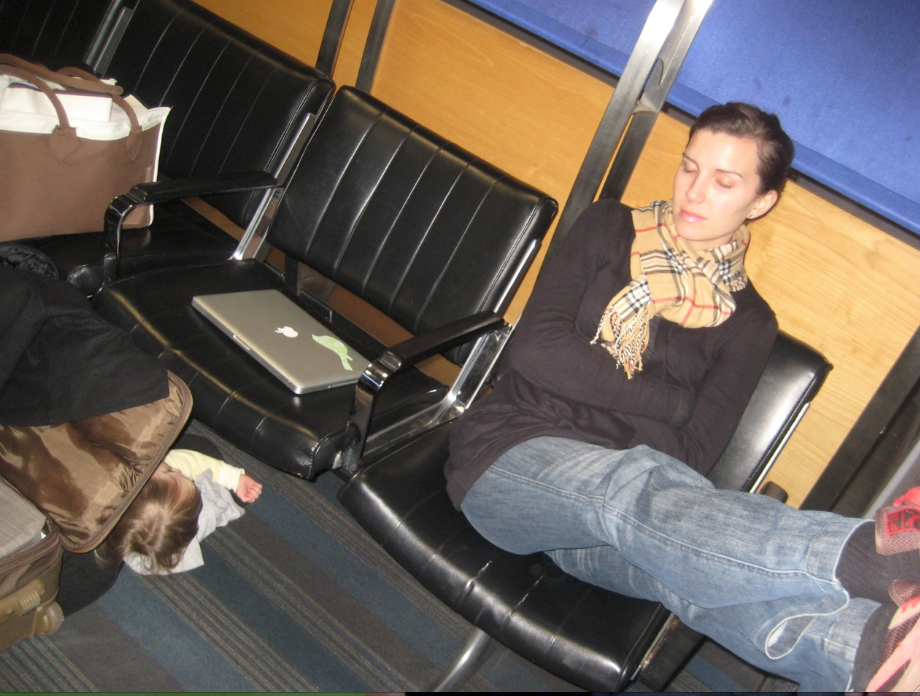
Screen shot 2013-10-23 at 9.35.19 PM

This picture will forever make me laugh.  It was taken two years ago, on a crazy-long (over 24 hours) trip back to the US.  It was our yearly winter visit, and for some reason everything on this trip went wrong: flat tires, delayed flights, missed flights, you name it. But what’s so funny about this picture  (besides my sad/disgusted/hilarious expression) is that my then-20-month-old daughter is sleeping soundly under the airport chairs.

Yep.  Her sweet, healthy, clean little body is laying on the floor under the nasty, dirty, I-don’t-even-want-to-know-what’s-under-there, airport waiting chairs.  I remember resorting to this after she had been awake for some ridiculous number of hours, and this was the only way we could make a dark enough environment for her to fall asleep.

I laugh because this picture captures what travel seems to do to our family.  For some reason, time stops, reality stops, and a strange survival mentality of ‘anything goes’ starts to emerge.  By around hour eighteen I find myself saying things like, “sure honey, go ahead and eat the raisin that dropped on the airplane floor, that’s fine” or “just let her sleep on the floor” or “I say we buy one of those oversized M&Ms bags for $20 and eat it in one sitting.” Gross, right?  I’m actually a very clean and organized mom, but for some reason when the stresses of travel start to wear on me, I seem to slip into a strange ‘anything goes’ mode.

 Have you ever felt like this?  A season where time just stops and it seems your idea of ‘normal’ life is on hold?

I remember reading an article on the pressures of a being a ‘caregiver’ to someone, either as a family member or as a career.  What struck me about the article was that the best caregivers were the ones who don’t put their own lives on hold in order to care for the life of the other.  It’s one thing (and such a incredible sacrifice) to give up everything for a sick family member and become their carer every waking moment.  But I suppose it’s another thing (and incredibly hard) to care for someone constantly, while at the same time trying to maintain a healthy sense of one’s own life as well.  I think I face the second kind of struggle with parenting.  And similarly, I’m convinced that I’m a better mother to my daughter when I set aside time to take care of myself, or to be involved in areas of interest outside our family circle –basically, when I don’t wear my ‘mom hat’ 24 hours a day, seven days a week.

I feel like we’ve touched on this topic on TGW a few times, but as the new term is kicking off and we have some new readers, I just want to encourage you not to let time stop while your spouse or partner is in graduate school.  It’s a strange, isolating, and sometimes confusing time, but don’t give up your entire life in supporting your partner in his or hers.  If you’ve made career sacrifices by moving to a new place, start work as soon as you are able, or volunteer or take some classes on a new or old hobby.  Over and again, people have shared with me that a part of their dreams died when they signed on to be a supporter through grad school for their significant other.  Don’t do it!  Let the dreams take new shapes and avenues, but don’t let them die, and don’t put them on hold too long.

And don’t ever buy the $20 bag of M&Ms – it’s so not worth it! :)

-M.C.

Shuga' Mommas

Shuga Mommas: Tomato and Chickpea Soup with Fresh Basil Pesto

My husband is an avid runner. He’s also very disciplined about how he fuels his body; because of this, we try to eat very healthy in our home (and by we, I mean him) :). As I’m designated head chef in our home, he occasionally sends me recipe suggestions of different things to try so we aren’t eating the same things over and over and over.

Recently, he sent me a link for a tomato based soup with chickpeas, with a jarred pesto topping. To be honest, I thought it sounded a bit bland (not to mention a bit gross, given my love/hate relationship with pesto), and since I was missing several of the ingredients the recipe called for, I decided to switch the recipe around a bit to fit what was in my cupboard.

The result? AH-MAZING. Seriously, it will go on heavy rotation in our home this autumn and winter. It’s vegetarian, easy and inexpensive to make, freezes well, and tastes great. So, if you’re looking for another yummy soup packed with protein and fiber, that fits with a graduate budget, then this is your soup.

TOMATO SOUP WITH CHICKPEAS

Ingredients

  • 2 14oz cans of chopped tomatoes
  • 1 14oz can of chickpeas
  • 1 TBSP of olive oil
  • 2 cloves garlic, mince
  • 1 onion, minced
  • 1 red jalapeno, minced (I wanted a bit of spice in mine, so I added the seeds, but you can adjust to your desired level of spice)
  • 1/2 cup water
  • salt/pepper/sugar to taste

Directions

In a soup pot, sauté garlic, onion, and jalapeno in olive oil until soft. Add both cans of chopped tomatoes and water, and bring to a boil. Reduce heat to a simmer, adding a bit of salt, pepper, and sugar to your desired taste. Add chickpeas, and cook for an additional 10-15 minutes. If you prefer, you can puree this soup with a blender, or leave as is.

We paired the soup with warm French baguettes spread with olive oil and fresh basil pesto. I tend to use this recipe for fresh basil pesto, reducing the garlic to 2 cloves instead of 3 cloves. (I like garlic, but I’ve found this amount almost overpowers the pesto). You can use the pesto as a soup topping as well.

Enjoy!

~Mandy

Monday's Food for Thought

Monday’s Food for Thought: Shrinking Women

new food for thought

A video of Lily Myers “Shrinking Women” from the 2013 College National Poetry Slam has been circulating amongst my friends the past few days. While this particular poem deals with gender stereotypes, food relationships, and a host of other issues, the one thought I keep coming back to over and over and over is, “What am I teaching my child?”

Do my actions say something all together different than what comes out of my mouth? Will my son learn more from what I do, instead of what I say?

As Lily states about her own mother, “I never meant to replicate her, but spend enough time sitting across from someone, you’ll start to pick up their habits.”

What do you think?

Happy Monday,

~Mandy

Monday's Food for Thought

Monday’s Food for Thought: Can You Read People’s Emotions?

new food for thought

Can you read people’s emotions?

The NY Times recently released this little quiz regarding reading people’s emotions, which I found to be quite fascinating. Based on an assessment tool developed by University of Cambridge professor Simon Baron-Cohen, it measures how sensitive you are to other people’s emotions.

Do you think this is a good measure of how well you can read someone’s emotions?

Happy Monday!

~Mandy


Expectations

A Bit of Dish Division: Advice on Household Chores

One of the biggest questions M.C. and I get asked regarding graduate life is “How do we balance household chores? I work full time, he is in school full time. How should we make this work?”

I grew up in a very traditional home when it came to chores. My Mother took care of everything inside the home; my Father took care of everything outside the home. This arrangement suited them well, so they’ve continued this way for the past 40 years (although my Dad is quite handy with the vacuum today).

Naively, I thought it would look exactly the same when I married. However, I didn’t factor in working full time, commuting, or a husband who would attend grad school.

In the weeks leading up to our wedding, we were having dinner with some friends, and they shared a piece of advice with us when it came to household chores: we were to pick a chore we hated, then switch.

I hate vacuuming.

He hates grocery shopping.

For the past 10 years, he’s vacuumed and I’ve shopped for groceries, and our little once-a-week arrangement has worked. There have been times we’ve had to step in and help each other out (especially during grad school), but there’s never been a doubt who owned that particular chore. We have balanced other household chores between us.

I know every relationship is different, so our little arrangement would not work for everyone. However, I’ve included some helpful tips below that I’ve picked up from various grad school wives:

What is your priority, and what are you willing to compromise? – Is having a clean house the most important thing to you? Is he a neat freak, and you’re the one with clutter? Are you still cleaning at 2am? You have to decide what is important for your family, and what you can compromise, then stick with it. A friend of mine in graduate life who stayed home with her children decided when they were young she would do one deep clean of her home a month. The rest of the time was spent maintaining, and she often had a messy home; but her trade-off was spending more time with her children. She felt absolutely no guilt for her messy home, as it was obvious where her priority was. I admired the way she owned her choice!

How do you communicate?- This may seem like an obvious one, but do you discuss your chores? I have a friend who worked full time while her husband was in grad school. While he helped out occasionally around the house, she did most of the household work. After awhile, she grew incredibly resentful because she felt like he was taking advantage of her. She finally convinced him to sit down to chat about it, and he grew defensive when she said she felt like she was doing everything. They managed to come to an agreement: for one week, they would keep a chore chart of every household chore completed for which they would earn one point. At the end of the week, they compared points: She had 25, he had 7. Believe it or not, several years later, they still do this, and now it’s easy for them to say to one another, “I’ve done the dishes 5 evenings this week, do you think you could do it for the next few evenings?”

Have you tried chore charts? – Chore charts (like these on pinterest) are incredibly popular, but they didn’t and wouldn’t work for us. Our schedules were always all over the place, so I’d always end up doing Monday’s chores (along with the rest of the week!) on Saturdays. :) For friends of ours living in shared graduate housing, they found chore charts to be essential, since they needed to communicate with more than just one other person. They would have a once a month meeting in the house to determine who was doing what chores for that particular month, and then the chart was hung in the kitchen for all to see.

Please don’t nag me! –  Back when we switched our hated chores, I found myself telling him how and when to vacuum. (He’s a GROWN MAN with a PhD, y’all. He knows how to run a vacuum). Two weeks into it, he said to me, “If you’re going to constantly nag me about this, I’m not going to do it.” Point taken. Remember that compromise thing? I accepted that it was no longer my responsibility to point out how and when his chores would be done – he already has a mother. :) We agreed he’d vacuum once a week, and I left him to it.

The graduate season tends to be a bit disorganized – there’s dissertations to write, exams to take, fellowships to engage in, and rounds to make. I know there will be times we’ll have to pick up the slack. The last year of my husband’s dissertation was also the first year of our son’s life. My husband was trying to finish his PhD, carrying a large teaching load, and trying to be a good husband and father. He had no capacity for anything else. For that year, I stepped up and did most of the household chores. After he submitted his dissertation, we reevaluated how we would manage chores going forward (especially since our home now contained a very fast, messy toddler).

How do you manage chores in your home? Do you find it to be a struggle? Would you give us any of your helpful tips in the comments below?

And remember, if all else fails, you could do what some friends of ours recently did after bickering for months around cleaning schedules, study schedules: they reviewed their budget, and decided it was worth their sanity to hire a cleaner. Oh the dream!

Happy cleaning,

~Mandy
Wednesday's Weekly Tip

Wednesday’s Weekly Tip: 35 Money-Saving Home Decor Knock-Offs

wwt

If you’ve read this blog for any amount of time, you’ll know quite well which one of the two of us is the ‘artsy’ one. (Hint: It ain’t me!) I’ve been friends with M.C. for almost 4 years now, and she constantly impresses and surprises me with her creativity. I’ve seen her take something I think should be destined for a life in a landfill, and turn it into something beautiful. One of the more amazing tricks I’ve seen M.C. do time and time again is see something she likes, then make it. She’d end up spending pennies for what you’d pay for it in a store. It’s a gift, people.

When a graduate wife reader sent this article on making home decor knock-offs, I knew I’d have to post it. Since we’ve just moved into a house for the first time in 9 years, and I have a very small decorating budget, I need all the help I can get – both for saving money and DIY projects.  I thought it might be helpful for you, too! Anyway, for those of us who can’t and won’t pay the prices at Potterybarn or Restoration Hardware, but like the designer look, then this article is for you.

And now, this is next on my list of things to do in my son’s room, his very own growth chart. Wish me luck!

~Mandy

Credit

Monday's Food for Thought

Monday’s Food for Thought: Free Light

new food for thought

Alfredo Moser is famous, but you would never know it.

The Brazilian mechanic devised a method to give his home electricity during the day – using plastic bottles filled with water and bleach. Over the last two years, the method has taken off in over 15 different countries, where electricity is expensive, especially so for those below the poverty line. As Moser’s Lamps continue to provide free light to an estimated one million homes next year, allowing them to light their homes to work, and in some cases, grow food, he has expected nothing in return. Instead, he has given the world a gift.

Mr. Moser states in the article (which also contains an amazing video of how the lamps work):“It’s a divine light. God gave the sun to everyone, and light is for everyone. Whoever wants it saves money. You can’t get an electric shock from it, and it doesn’t cost a penny.”

A wonderfully positive story to kick off your Monday!

-Mandy