Monday's Food for Thought

Monday’s Food for Thought: What motivates us?

My husband is nearly finished with his doctorate and currently wading through the muddy waters of searching for an academic job or post-doc and so, understandably, I found this video about what motivates humans quite interesting.  It isn’t earth shattering news or anything.  In fact, I’d bet that most of you will nod along and by the end of the video will want to join me in saying, “Well, duh! I didn’t exactly need ‘science’ to tell me that!”  But it did get me thinking; In the publish or perish world of academics, where young professors often make enormous sacrifices to secure tenure in order to provide for their families, what would it look like for higher education institutions to motivate academics (like my husband) with these ideas?  And it made me wonder what university would look like if we could motivate students with these ideas.  Food for thought this Monday.

What do you think?  What is the strongest motivator in your work and/or personal life?  What about your spouse?

-Deanna

 
Expectations · Vocation/Gifts/Calling

His “Work”

his work

So I am not a big fan of books that seem like ‘self help’ books.  And I am also not a big fan of books with cheesy titles or even worse, cheesy cover designs.  So when I was first married and someone handed me a copy of ‘The Power of a Praying Wife’ (with an awkward picture of an open window and a lily on the cover), I cringed.  However, after a few months of marriage I quickly learned that it’s not quite a piece of cake and I decided to pick the book back up.  To my surprise it was really indeed quite ‘powerful’ and offered a lot of insight and good food for thought.

I know many of you might not share a similar faith as I do, but I do think we probably all share a desire to support our husbands and to be together as a team on this crazy journey of marriage, especially through this season of graduate school.  So when I recently stumbled across my old copy of this book and began to thumb through the pages, I thought I’d share.  There are around thirty little sections or chapters in the book that each focus on a various topic to pray through for one’s husband.  Surprisingly (or maybe not so surprisingly) the first topic listed from this extensive list is ‘His work’.

In this section titled ‘His work’, the author begins by illustrating two differing extremes.  In one situation the husband is quite lazy and the wife does all the work and then some.  The second situation describes a husband who is a workaholic and doesn’t ever take time out for his family or his health.  She goes on to describe a healthy balance between the two and says, “What causes a man to go to either extreme can be, oddly enough, the same reason: fear.  That’s because a man’s identity is often very tied up in his work.  He needs to be appreciated and he needs to win, and his work is often a means of seeing both happen.  It frightens him to think he may never experience either.  If he is doing work that is demeaning to him, he feels devalued as a person.  If his work is not successful, he feels like a loser.”

I started to think about how my husband would consider ‘his work’ and how I consider ‘his work’.  I find that sometimes I write off ‘his work’ as just ‘school’…or I tend to sometimes just picture him chilling out in the library drinking lattes and being all cool and philosophical.  I am almost continually reminding myself about how exhausting and challenging his PhD work actually is and I have written about that here.  I have to remind myself how much his work affects him and how the excerpt above really does apply to his grad school work.  His work doesn’t look like say… a big shot businessman’s right now, but it is very much the same thing.  It really is something that shapes and fuels and defines him in so many ways.

So to conclude, if their work really is all that important and actually does offer them so much identity (and there about 9,000 journal articles out there that suggest this), then we should be taking this seriously, right?  We should be thinking about how to make sure our grad school spouses are feeling fulfilled and encouraged, and we should be thinking through how to help them keep a healthy balance and perspective on their work.

What do you think?  How does your spouse/you view their ‘work’ in grad school? 

How have you handled this work-identity issue when dealing with your grad school spouse?  (Especially if one of you is working full time outside academia, so that you can support your spouse who is in school.)

-M.C.

Monday's Food for Thought

Monday’s Food for Thought: Would you let your child sleep outdoors in sub-zero temperatures?

I saw this article last week, and thought it was absolutely fascinating. It’s a well known joke amongst most of our English friends that Americans like to keep their homes ‘boiling’ hot. Compared to most of our English friends, and the temperature I currently have set in our flat, I would say that in most cases that’s probably correct.

Children in Europe seem to be conditioned to the cold weather, and at least for me, this article confirms that. I didn’t let my son sleep outside when he napped as a baby/toddler, but he handles the cold weather better than I do. I do remember my own parents turning down the heating at night stating, “You sleep better when the room is colder.”

What are your thoughts? Would you let your child nap outside in sub-zero temperatures? Do you think it is helpful or harmful?

~Mandy

Professional Careers

A Bit of Brain Stimulation

mail

-Written by ML, a current graduate wife

Before I joined my now-husband where he is attending grad school, I was completing a fairly distinguished internship. Unfortunately this was also the year of the big economic crash. Just as I began to job search, companies were forced into hiring freezes and lay-offs. I decided that if I was going to be unemployed, I might as well be in the same town as my boyfriend.

After a couple more months searching for a good job, it was time to take one that would pay the bills.  There aren’t a lot of opportunities here for grad spouses, and if they can manage it many of them don’t work at this stage in their lives, but for us that wasn’t an option. While my job does pay the bills, it doesn’t do much else, and I soon found myself seriously searching for some brain stimulation.

If you’re looking for the same, hopefully this helps.

Take Classes

Probably the most obvious answer, but there are several ways to go about this. You can enroll in a class for credit, but this can be costly. If you don’t need credit, find out if your spouse’s school will let you audit them for free. Many universities offer free recordings of classes online. What better way to learn something that’s not in your field than online in your home, without any homework or witnesses, to show you just how little you know about the topic? A lot of schools offer adult continuing education courses either online or in person. These are generally cheaper (and more fun) than a regular class. If you do want credit it doesn’t have to be at the same school your spouse attends; community colleges or other local schools can be more cost effective.

The Library

Public libraries often have evening courses for adults. If they don’t offer what you’re interested in, ask about starting one. The topics for these are more creative, less time consuming, and less intense.

Volunteer

Many places offer opportunities to volunteer. An upside to this is often flexibility. Don’t just look for a place that’s in your field – look at the fields places have to offer. Our local aquarium, for example, needs volunteer biologists, divers, educators, marketers, and staff for events.

Join or Start a Club

Reading, knitting, working out, or whatever floats your boat. See if there’s a club for that. Look beyond the college to the community for a broader range of things.

Read, read, read. I read before work so that my morning isn’t just about getting up, getting ready for work, and going to work. I read pretty much any time I can. No matter how flat I feel my brain is getting from work, it feels good to be able to hold an intelligent conversation around my husband and his colleagues.

Listen to Podcasts

What a great invention! I don’t do my hair in silence any more. Instead, I listen to an informational and highly entertaining podcast. I can listen to and from work, while I do the dishes, and while I’m at the gym.

Having a job that doesn’t stimulate you isn’t ideal, but sometimes it’s what we have to do. Let’s make the best of it!

What do you do for brain stimulation? If you have other ideas you’re welcome to leave them in the comments. 

Uncategorized

END It

image_overlay

Celebrate!

Celebrate new beginnings!

Keeley1
Written by Keeley, a current graduate wife
It has been one week since my husband, Jason, received an offer as Assistant Professor of Global Christianity at Arizona State University, and it still feels pretty surreal. We got the call in the middle of Old Navy, and when we didn’t recognize the area code, and he had been outside the store talking for over ten minutes, I figured I knew what was up. When he told me the news, I didn’t know whether to laugh, cry, or take a nap (odd impulse, I know, but that’s how I honestly felt). We are both so relieved and excited, if a little overwhelmed at the prospect of having our first baby in June and then moving across the country to his new job about six weeks later. But, I wouldn’t have it any other way. It’s impossible for me to verbalize how grateful I am for Jason, for his hard work, and for the search committee seeing what I see in him–it feels as though all the mornings getting up before dawn and all of the papers, articles, and research trips might be worth it in some way besides general “life experience.” The only problem is that we will have to put our cat ranch plans on hold, but I think I can live with that for now!
(p.s. we will probably have to put those winter clothes away for a while too! yahoo!)
Monday's Food for Thought

Monday’s Food for Thought: How old is too old?

Did you see this piece in the Huffington Post last fall? A friend shared it recently and I had to post it.

Screen shot 2013-02-24 at 3.28.37 PM

“How old is too old?

To let your toddler play on the lawn in his skivvies?

To still use a bottle? Wear a bib? Need a nap?

Parents wonder, and also judge.

Back when Vittoria Cerioli was an infant,her mama, Licia Ronzulli brought the girl to work — which just happens to be the floor of the European Parliament in Strasbourg, where her mother is an Italian representative.”

______

This piece is fascinating to me!  Scroll down to see the slideshow at the bottom of the article.

What do you think?  Too far?  But where is the line?  Is there a balance?

And regardless of your thoughts, isn’t she the cutest little thing? :)

Some food for thought today!

-M.C

Finances

Money Saving Tips

One of the most difficult things about graduate school is learning to survive financially. I feel like I spend hours poring over our budget, trying to squeeze every last dime (or ten pence!) out of the boundaries we’ve set for ourselves. I know those financial boundaries are good for the long term, even though they seem utterly painful right now.

I know we all have different systems and processes for managing our money, but I thought I’d share some financial websites I frequent for tips on saving money, budgeting, and getting out of debt. These have been my go-to websites while navigating the financial perils of graduate school. I hope they help you as much as they have helped us!

Money Saving Mom – she was also a graduate wife!

Dave Ramsey – financial guru

Mint.com – for budgets with fancy graphs

Happy saving and spending!

~Mandy

Balanced Life?

Getting Your Hands Dirty

working with hands

Here’s the thing: I’m cool with not knowing where we might end up in two years when the PhD is over.  I’m cool with an academic wife’s life, or even the chance of not being an academic’s wife if my husband’s career path turns.  But what I’m not cool with is a life in academia (or any other job for that matter) that sticks my husband in front of a computer screen allllllll day long doing research.  Sigh…I know there’s not a way around that these days, but after our first year of PhD research, I realized that something needed to change.  I was not cool with him coming home exhausted from straining and staring, and totally spent due to the mental stress of being on a computer 24-7.

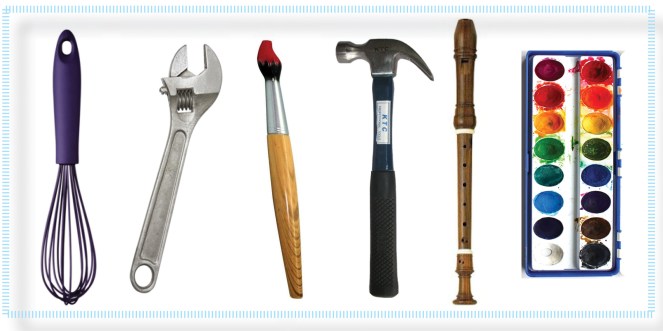
Don’t get me wrong – I love working on the computer.  I’m even a graphic designer on the side; there is, however, no denying that there is a profound difference between holding a knitting needle, a wooden spoon, a paint brush, a screwdriver, a garden hoe, and a musical instrument, on the one hand, and putting one’s fingers to a keyboard, on the other. Both can produce amazing results, but only one can give you something to touch, to eat, and to rip up. There’s a sense in which engaging with the tools of craftsmanship forces the artist into a relationship with creation. Conversely, could it be the case that typing on a computer all day fosters isolation from the world?

From what we have experienced, working on the ever-evolving and translucent (almost imaginary) world of PhD research can certainly leave you feeling disconnected from the tangible, material world around you. It can often leave you exhausted and frustrated because of the hard work necessary to produce something invisible, something that can never be held in your hands (until it is printed on paper).

Over the past few years of grad school we’ve noticed this tension, and as you can tell from my rant above, we desperately needed to do something about it. We started asking, ‘how can we make this PhD process more humane, more liveable, more energizing?  Put more simply, how do we avoid letting my husband become drained from his research?

Here are a few of our attempts at answering that question:

We started with a ‘makeshift’ workshop.  My husband has always liked bikes and taking care of them, so we’ve collected quite a few used bikes in our tiny garage.  They are great for when friend’s come to town or if a friend here needs an extra to borrow.  He spends time fixing these bikes up and then selling them off again, and he even offers to help fix friends’ bikes as well.  It’s not a weekly thing or even a monthly thing (although I know he wishes it was), but it’s a start.  The tools and set-up are there.  It’s a chance to connect to something tangible, to feel a sense of accomplishment by seeing a task come to completion.

Cooking is another area in which we have tried to foster this idea.  Anyone who has known me longer than seven months would probably share that I was a pretty average cook.  And I must confess (to my sister-in-law’s dismay) I used to buy fajita/chilli/taco/cous cous pre-made spice mix packs.  I was that kind of cook, even though there is nothing inherently wrong with the method.  I just wasn’t an adventurer in the kitchen.  Due to some health issues I’ve touched on before, we decided to go gluten-free and dairy-free.  It’s become absolutely therapeutic to dive into the joys of cooking.  Maybe my friend Laura will share a bit more on that one day, but for now, let me just say that cooking is powerful and healthy for one’s soul.  It’s real, gritty, messy, savory, satisfying and incredibly intimate when shared.  My husband and I definitely don’t cook together every night, but when we do (or when we make dessert, which is more often the thing we create together) it’s cathartic and stress-releasing and freeing.  And it’s so rewarding to see and enjoy the result of your hard labor -only a few minutes later.

And music: an art of creating something beautiful from nothing.  We cherish taking time to close out the virtual world and listen to the stillness and the rhythms around us, to create order and harmony.  I make us sound like aspiring composers.  Very far from it, but the small act of buying a keyboard for our living room has been incredible (I know design friends would find it an eyesore, but I am working on a cute skirt for it).  Digital, I know. I wish we had room for a real piano. Regardless, it is inspiring and cathartic to sit down and conjure up tunes. I’ve watched my husband unwind as he starts playing something for my daughter, and it has provided us with hours of helpful stress release.

I share this in the hopes of helping someone out there with the almost anchorless reality that the PhD can sometimes bring.  We’ve found ways to find fulfillment and satisfaction, and a bit of stability, in a few of the ideas shared above.  We’ve found that making time to engage the material world brings us back to reality and takes the microscope off ourselves and our research.  So, if you find yourself in a place like we were, and you need a balance of hands-on, real world craftsmanship to pair with your mental exercise, perhaps finding your inner artist through a tactile hobby is your answer.

-M.C.

Monday's Food for Thought

Monday’s Food for Thought: Tiny Houses

Basically since my husband and I have been married, we have lived in subsidized graduate housing about which we have had little choice. My personality is the type, frankly, that I have been delighted to have to worry about “one less thing” in choosing our place of residence. During this time, we have learned to make the most of the square footage we have and to purge continuously whenever we move or receive gifts of material goods. In considering housing over the past couple of years, we doubt the ease or possibility of it, but have been fascinated by companies such as Tumbleweed Tiny House Company, begun by Jay Shafer. In all likelihood, we will probably continue to rent or buy something affordable in the next stage of our journey, but we kind of salivate looking at these homes and imagining the purpose and intention they would undoubtedly give to our lives (and our stuff!). Maybe you will have fun browsing them as well!
-Keeley